

Table of Contents
The PCB ruler is one of the tools that has become extensively adopted by designers. To assist designers, engineers, and manufacturer at various levels of PCB development, this professional measuring device is crafted to provide accurate estimations, reference data and component prints.
This guide will cover the definition of a PCB ruler, its features and benefits, how to choose the perfect one, and how to create a custom one. Learn with ELEPCB now!
What is a PCB Ruler?

A circuit board ruler is a measurement device specifically utilized for PCB operations. The rulers are sturdy enough to be made of materials like metal or FR-4, and hence they are long lasting and accurate. They indicate a variety of markings such as component prints, estimates, and other guide books. These components are designed to help with appropriate PCB planning and gathering methods. The major features of PCB rulers are as follows:
- Shows both imperial and metric measurements
- Markings for PCB trace width, and wire gauge
- References for resistor and capacitor measurements
- Pinouts and electrical benchmarks for common parts
PCB Ruler Features

Measurement Units & Scales
- Metric (millimeters) and Imperial (inches)
- Silkscreen printing or laser engraving
Electronic Reference Charts
- Resistor color code chart
- AWG (American Wire Gauge) references
- Copper thickness
- Current capacity tables
- Capacitor value conversion
Advantages of PCB Ruler
Component Layout Estimation Accuracy
The accurate readings by the ruler enable the makers to plan and organize components on the board to a high level of precision. This assists in avoiding design mistakes and optimal positioning of components within the available space.
Shape Visualization and Design Validation
PCB rulers provide accurate measurements and adherence to width standards. Additionally, they provide component impressions, enabling manufacturers to visualize electronic components’ dimensions and form. This helps check designers if the components fit on pcb with respect to their footprint for their final product.
Improving Execution Follow Width
All PCB rulers include width references, which designers apply to determine the appropriate width taking into consideration aspects like current carrying capacity. The manufacturers ensure that the PCB will be in a position to sustain the indicated electrical current without any problems of implementation or overheating using such references. Using a PCB ruler saves time and is less likely to be wrong, which results in quality PCB designs.
Considerations for PCB Ruler
A few factors should be taken into account while choosing a PCB ruler in order to ensure its accuracy. The following factors are essential to be certain:
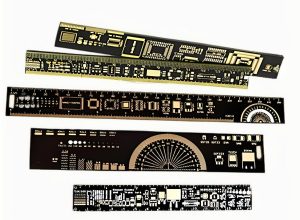
1. Material
The material is one of the most important considerations when choosing a PCB ruler. FR4 (fiberglass PCB material), aluminum, and stainless steel are common options.
FR4 is affordable, lightweight, and closely resembles standard PCB boards, making it a great option for those looking for a cost-effective option, but it is not as durable as metal options. PCB rulers made of aluminum and stainless steel provide better solidity and a premium feel, but they can be more expensive.
2.Scale Readability & Accuracy
Scale readability and accuracy are two fundamental considerations. Both metric (millimeters) and imperial(inches) scales should be included in a well-designed PCB ruler so that users can regularly work on universal projects.
Since printed markings tend to blur over time, the markings should be laser-etched or engraved rather than silk-screen printed. To prevent calculation errors, which appear to result in design defects in PCB formats, it is also essential to ensure factory-calibrated precision.
3. Durability & Wear Resistance
Selecting a ruler with excellent etching and robust properties is essential for durability and wear resistance. Because they do not blur with increased use, engraved or laser-etched markings are more durable than silk-screened prints.
Gold-plated (ENIG) edges can advance wear resistance and provide the ruler with a cleaner appearance when selecting an FR4 PCB ruler. To prevent accidental short circuits when used near electronic components, metal rulers should be coated with a non-conductive substance. Avoid lead as it is dangerous.
4. Cost Availability
When choosing a PCB ruler, you need to consider the cost factor. FR4 rulers are often the most affordable. However, because of their durability, aluminum and stainless steel are more expensive.
Since custom PCB rulers typically need to be ordered in large quantities, it is best to choose a manufacturer with minimum order quantities (MOQs) to keep prices down if you are planning to use one for branding.
5. Use Scenarios
If you work more often with boards of larger size, such as some of the biggest boards of equipment in the industry of industrial controls, their size can be dozens of centimeters, or even more. In such cases, the “ruler 12 inch” (or about 30.48 cm) is definitely useful. For example, when measuring long distance wiring traces on a motherboard, the measurement can be done in one stroke without needing to move and reassemble the measurement results several times like with a short ruler, thus improving the accuracy and efficiency of the measurement.
However, in other miniaturized PCB design situations, for example, PCB boards in smartphones, wearable devices, etc., the PCB boards will be tightly packed in a small space. For such a situation, a 3-inch or 6-inch PCB ruler is more suitable.
The 3-inch (approximately 7.62 cm) PCB ruler can be easily placed in a tight space to measure line lengths, component spacing, and other specifications precisely while measuring lines around densely packed chips on smartphone PCB boards. Besides, this ruler size is easy to carry, making it simple for engineers to move between different work sites frequently.
The 6-inch (~15.24 cm) PCB ruler is a compromise which adapts to a certain range of measurement and work flexibility in the miniaturization scenario. In order to measure relatively longer lines in the PCB board of wearable devices, or to carry out a more full-scale measurement on localized small PCB boards, the 6-inch ruler can be used. At the same time, during the layout design of small PCB boards, a 6-inch ruler can also provide sufficient reference scale.
How To Design Your PCB Ruler?

Step 1:
Set up the Strategy
Step 2:
Open-Source Ruler Design Tools
Select particular highlights and estimations, such as component impressions, widths, and enter sizes, that you would like to incorporate on your ruler.
To make your ruler design, utilize a computer application such as EasyEDA, KiCad, or Altium Maker. These extensive records include a variety of pinouts, equations, schematic images, microcontrollers, and other useful references, which you can drag and drop onto your claim PCB ruler design.
Utilize component libraries, and check the accuracy. These tools are helpful for designing your PCB. For hobbyists and beginners, open-source tools such as KiCAD, and EasyEDA are available.
If you want to learn more about specialized PCB design software, check out this popular ELEPCB blog post for more information.
Step 3:
Choose a Suitable Material
When choosing a material for your ruler, consider components like solidness and resistance to common substances. Aluminum or FR-4 fiberglass are prevalent alternatives.
Step 4:
PCB Ruler Gerber Files
The format of your PCB ruler is contained in a Gerber record. After downloading the Gerber record, open it with EasyEDA or KiCAD. Examine the layers of the design in two ways:
- Are microcontroller pinouts and other essential parts found in the top layer?
- Are formulas, component impressions, and additional references stored in the foot layer?
Modify the format as necessary. Although you can transfer elements between layers, be aware that some shapes might appear inverted when you move them to the opposite side.
Step 5:
Choosing Your Board Outline Components and Footprints
- Microcontroller Pinouts: Useful for quick reference in embedded design.
- Component Footprints: Include SMD footprints, DIP package sizes, drill hole sizes, and pin pitch references.
- Electronics Formulas: Add important equations like Ohm’s Law, power equations, and resistor color codes.
- PCB Design Rules: Include trace width vs. current charts, clearance spacing guides, and via size references.
- Custom Branding: Add logos, QR codes, or web links if you’re making a branded ruler.
Step 6:
Export and Fabricate
Step 7:
Examine and Test
Select a reliable maker and send out your ruler PCB design in Gerber. Show the color of the fixed shroud, copper weight, cloth, layer stack-up, and silkscreen slants. Give the essential documentation and data while following the manufacturer’s rules for productive manufacturing.
After you accept your customized PCB ruler, thoroughly examine and verify its accuracy. Verify the estimates using a reference.
Conclusion
PCB rulers proceed to be basic devices within the field of PCB design and production. Despite the accessibility of Web devices, physical PCB rulers give fundamental highlights for real PCB plans. They give exact calculations and advance exact component accuracy. Designers and manufacturers may increase productivity, decrease blunders, and make broadly utilized, high-quality PCBs by utilizing PCB rulers.
Still looking for high-quality PCB manufacturers? Check out ELEPCB! You can simply contact us or get a quote below or send us an email at info@elepcb.com.
FAQs
A1: It depends.
For large PCB manufacturers, producing their own PCB rulers can be cost-saving in the long run. Through in-house production, they have better control over production and quality, and products are assured to pass precise standards and specifications. Producing their own PCB rulers can be designed to suit the company’s specific needs, such as size, material and precision requirements. Besides, some PCB manufacturers may wish to conceal their technology and processes.
Still, for small to medium-sized PCB business hobbyists or manufacturers, the more affordable way to go is to choose branded products that are well-established.


CONTACT US




 English
  Italian
  Hungarian