

Table of Contents
Since IC testing is crucial to modern electronics, extensive testing is required to guarantee their dependability and functionality. This post’s primary objective is to provide excellent integrated circuit testing instruction. It’s meant for both experts and people who love electronics. Knowing testing methods helps people check for quality, solve problems, and ensure integrated circuits (ICs) work properly. This is important for keeping electronic systems reliable.
So, let’s follow ELEPCB to find the solution!
What Is An Integrated Circuit Test?
IC testing ensures that chips work correctly because testing integrated circuits (ICs) is important for finding problems and checking if they function properly. So, to find potential issues early, engineers run simulations of the IC’s (Integrated Circuit) operation during the design checking phase of testing. Special tools are used during the testing process to get correct results.
Why IC Testing Matter?

Integrated circuit testing is important because it finds problems early and saves time and money. This process improves product quality by reducing the chances of failure and making the ICs last longer. So, with IC tests, manufacturers ensure how well they work, meet industry standards, and build customer trust.
Before the testing of integrated circuits, we are supposed to perform an IC analysis, which includes but is not limited to four aspects: design verification, functionality testing, reliability testing, and performance optimization, or more precisely, its scope covers design verification test, diode and transistor tests, parametric testing, reliability testing, memory testing, boundary scan Testing and functional tests.
For the analysis of IC, we can make a global plan for all of these four aspects; thus, it is very important.So, let ELEPCB introduce the types of IC testing to you.
Types of IC Testing
Testing integrated circuits (ICs) involves several steps and each testing stage is made to find possible problems, check if the specifications are met, and make sure the IC lasts under different conditions.
Here’s an easy explanation of some prominent test method and what it does in the IC testing process:
1. Design Verification Test
Engineers copy how the chip works during the design checking stage to find any design problems early. By spotting problems early, we can prevent costly changes later in production.
2. Wafer Testing
Before the separate chips are cut from the wafer, testing is done on the whole wafer to catch any bad chips early in production.
3. Diode and Transistor Tests
Tests for diodes and transistors check that these parts are positioned correctly and working properly.
4. Parametric Testing
The purpose of parametric testing is to determine whether the electrical characteristics of the IC, such as voltage, current, and resistance, fall within the appropriate range. It is helpful for finding performance differences that may affect its functionality.
5. Reliability Testing
In reliability testing, the dependability of the IC is ascertained for a certain period. An ion tester is added in this process. This is realized through exposing the integrated circuit to extreme conditions like fluctuating temperatures and accelerated aging. This will help highlight some potential problems that may not appear immediately.
6. Power and Ground Integrity
The correctness of the power and ground connections can be identified, and problems like broken and/or closely packed connections can be detected with the help of ICT.
7. Burn In Testing
Burn in testing expose the ICs to high temperatures and voltages for a prolonged time to guarantee long-term reliability. This speeds up the wear process and reveals any early-life faults. Burn in testing improves the product’s reliability by removing weak ICs that could malfunction soon after deployment.
8. Environmental Tests
Environmental tests that expose ICs to high temperatures evaluate their additional durability and ensure their function well in the broad temperature ranges needed for applications such as industrial and automotive systems.
9. Memory Testing
Memory testing examines how information is stored and retrieved to check whether the IC (integrated circuit) memory parts work well.
10. Boundary Scan Testing
Boundary Scan Testing checks the circuits and connections of an Integrated Circuit (IC) using a method called JTAG. It is beneficial for finding mistakes in digital designs.
11. In-Circuit Testing (ICT/I test)
When an IC is connected to a larger circuit board or system, in-circuit testing verifies that it functions as intended. Electronic items that have been constructed are frequently tested using this method.
12. Yield Analysis
Yield analysis checks the percentage of good products taken from a wafer to find and fix problems in manufacturing that affect the number of good products made.
13. Functional Tests
While not as detailed as full functional testing, ICT can perform basic checks on components like integrated circuits and microcontrollers to ensure they work correctly in normal conditions.
- Automated Test Equipment (ATE)
Advanced technology is used by Automated Test Equipment (ATE) to simplify the process of testing huge volumes of products. It quickly and accurately checks how well things work, helping to minimize mistakes and save time.
14. Signal Integrity
Signal integrity tests are very important because they ensure signals are sent clearly without distortions, interruptions, or loss. This is especially true for integrated circuits (ICs) in communication devices.
The I Test Process

I Test is also called In-Circuit Test, and it mainly consists of using a dedicated ICT tester with connections to the pre-arranged test points on the PCB via a ICT machine to verify components’ electrical properties and soldering against open-circuit or short-circuit problems.
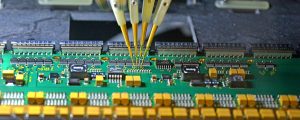
Test points are carefully added to the circuit board during the design process to make reaching and checking each part easier. The ICT machine often uses a testing tool called a “bed-of-nails” fixture. Different probes on this tool fit well with the test points on the circuit board. The probes touch the test points when the board is placed on the fixture, creating a complete circuit for each part. This is how manufacturers and engineers perform IC tests.
- Setting Up Test Fixtures
- Program Loading
- Power Supply
- Electrical Connection Testing
- Component Verification
- Data Collection and Analysis
- Fault Diagnosis and Reporting
- Re-testing After Repair
How To Test Integrated Circuit With Multimeter?
A key part of fixing electronics is using a multimeter to check integrated circuits.
To measure voltage, current, or resistance, first set the multimeter to the appropriate preset.
Step 1
10%
Next, verify that the power supply voltage is right by looking at the IC's VCC and GND pins.
Step 2
20%
Check that the voltage satisfies the datasheet's specifications.
Step 3
30%
Next, look for broken or connected paths by testing for continuity.
Step 4
40%
To check the connections, put one probe on a spot you know is grounded.
Step 5
60%
Test if there's a connection between the different pins of the IC.
Step 6
80%
Recheck the resistance of essential parts like resistors and capacitors to ensure they are working correctly
Step 7
100%
What Causes Integrated Circuits to Break Down?

Many things can make integrated circuits (ICs) malfunction or stop working. This can happen when we make them when we use them, or because of outside factors. Here are common outside and inside reasons why integrated circuits stop working:
1. Internal Causes
Reasons Inside the Company for Mistakes in Production
- Process Variations:
The performance of the integrated circuit may be harmed by dirt, unevenness, or contamination resulting from variations or issues in semiconductor manufacture.
- Electrostatic Discharge (ESD)
Electrostatic discharge, or ESD, occurs when electricity that has accumulated on one object’s surface abruptly transfers to another. When handled or made, electronic parts can get hurt immediately or later due to sudden static electricity.
- Mechanical Stress
When handled, installed, or used, the IC can be damaged or develop tiny cracks due to bending, flexing, or shocks.
- Problems with software
Mistakes in the firmware or software that controls the IC may cause it to work incorrectly and damage the device.
- Mistakes in Design
Bad designs can cause problems. Some examples are insufficient testing, not leaving space for changes, and not considering how things work in real situations.
- Manufacturing Process Changes
Changes in the manufacturing process, if not appropriately validated, may introduce new failure modes or reduce the reliability of integrated circuits.
2. External Causes
- Overheating
High temperatures due to excessive power consumption, high ambient temperature, or inadequate cooling will produce stress and reduce the reliability of integrated circuits.
- Electrical Stress
When the voltage exceeds the safe limit, the integrated circuit protective layers may fail, and it can be irreparably damaged. Too much current, further, can heat semiconductor materials or wire beyond tolerance.
- Wear and Aging
With the flow of electricity, metal atoms in wires can drift over time and cause short circuits. With age, too, all integrated circuit (IC) materials degrade and their reliability and performance deteriorate.
- Ionizing Radiation
Ionizing radiation, especially cosmic rays or radiation from space, can also cause problems and errors in integrated circuits.
- Dirtiness and Moisture
If dirt and moisture intervene over time, metal parts and other components may rust or break down.
Conclusion
IC testing necessitates a methodical approach to guarantee reliability, functionality, and performance. Manufacturers use visual inspection, automated testing, software-based testing, electrical testing, functional testing, signal integrity testing, parametric testing, environmental testing, and stress testing methods for IC testing.
If you want to know more details about the pcb manufacturing process, contact ELEPCB to find the solution!


CONTACT US



 English
 Italian
 Hungarian