

Table of Contents
PCB manufacturing CNC machines is your go-to solution for efficiently manufacturing printed circuit boards (PCBs).These CNC manufacturing systems allow you to create precise circuit patterns and holes using automated processes like milling, drilling, and routing.
Therefore, CNC machines are ideal for prototyping and small-scale production. In this article, we’ll explore every process step, from an idea to the final PCB product.Learn with ELEPCB!
What Does PCB Manufacturing CNC Machine Define?
The Computer Numerical Control (CNC) System is the brain of your machine, interpreting your design files and controlling the movement of the tools. These systems automate essential tasks like drilling, routing, and milling by combining advanced software, high-precision motors, and cutting-edge tools. This allows you to produce high-quality PCBs with precision and ease efficiently.
- The Spindle is the high-speed rotating device that holds your cutting tools for drilling and routing.
- The Worktable is where you securely position your PCB material during manufacturing.
- Lastly, the Axes (X, Y, and Z) guide the movement of the spindle and worktable, ensuring that each operation is carried out precisely as planned.
Types of PCB Manufacturing CNC Machines
Several types of PCB CNC machines are available, each tailored to meet your specific manufacturing needs and production scales, including:
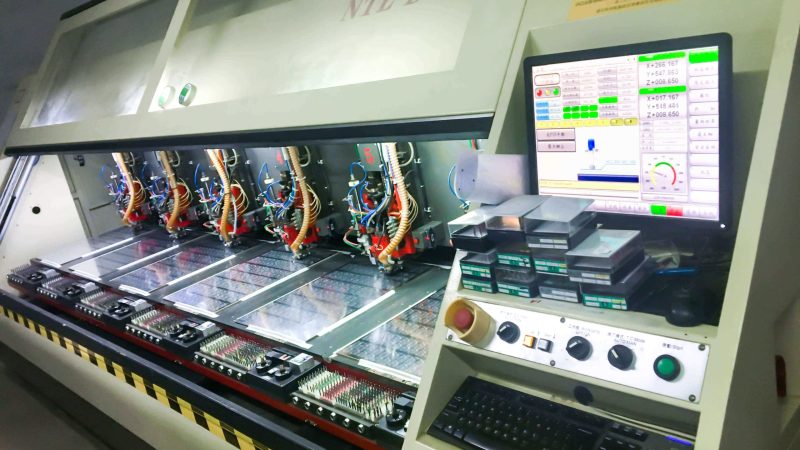
1. CNC PCB Drilling Machines
PCB drilling machines help you create the holes necessary for component placement and inter-layer connections.
- Mechanical Drilling Machines: These use high-speed spindles and drill bits to create physical holes in your PCB material. They’re perfect for producing larger holes and can accommodate various PCB thicknesses.
- Laser Drilling Machines: These machines vaporize the PCB material using high-powered lasers to create precise, micro-sized holes. They’re ideal for intricate designs and offer faster drilling speeds than mechanical options.
2. CNC PCB Routing Machines
PCB routing machines allow you to cut individual PCBs from larger panels and shape your boards as needed. They remove excess material using high-speed spindles and cutting tools, leaving behind the finished PCB. You can also use routing machines to create slots, cutouts, and other features necessary for component placement and assembly.
3. CNC PCB Milling Machines
PCB milling machines enable you to remove the top layer of copper to form your desired circuit pattern. These machines selectively remove unwanted copper by using small, high-speed cutting tools called end mills, leaving behind the traces and pads you need.
Milling machines are handy for prototyping and small-batch production, offering you the flexibility to make quick design changes without costly tooling.
Types of PCB Drill Holes
Focusing on their specific applications when categorizing PCB drill holes is helpful.
Here’s a quick overview of the different types you might encounter:
Plated Through-Holes:

Press-fit:
- These holes fit through-hole component leads and don’t require solder or filling.
Through-hole vias:
- Used to connect the top and bottom layers of the board, allowing signal transfer across any layer.
Blind vias:
- Connect a surface layer to an internal layer without passing through the entire board.
Buried vias:
- These connect internal layers without reaching the top or bottom.
Microvias:
- Small blind or buried vias, perfect for high-density signal routing.
Thermal vias:
- Designed to dissipate heat, not conduct current, by utilizing copper’s high heat transfer rate.
Non-Plated Through-Holes:
- Fasteners: Provide mechanical support for components that need extra stability.
- Mounting holes: Used to attach fasteners when vertical clearance isn’t a concern.
- Countersink holes: Recessed holes allow bolts to mount below the board’s surface.
Step-By-Step PCB Manufacturing CNC Machines For PCB Assembly Process
Step 1: Design:
You will draw your PCB design using specialized software such as Altium Designer or Eagle. This design file encompasses all the key details, from the board size to the placement of components and the circuit layout.
Step 2: File Preparation:
After design completion, you require converting the file to a format compatible with your CNC machine, like Gerber or DXF. That file will load the machine with instructions for operations needed.
Step 3: Material Preparation:
Now you cut your PCB material, which is normally a copper-clad laminate, to the right size and firmly mount it onto the work table of the CNC machine.
Step 4:
Use Of Different PCB CNC Machines for Different Purposes
Different types of PCB CNC machines can be utilized for your specific PCB
1. Use of CNC PCB Milling Machine in PCB Manufacturing

1. Use of CNC PCB Milling Machines in PCB Manufacturing
PCB milling allows you to remove material mechanically from a copper-clad board with electrical isolation, thus resulting in forming circuit patterns. Here, you use precision-controlled bits to carve out traces physically.
You can even command the CNC milling machine to trace your design layout, offering accuracy and repeatability at every process step. Here’s the general flow for CNC milling PCBs:
- Design: You develop your PCB layout using CAD and generate the appropriate CAM/Gerber files.
- Fixturing: You assemble the PCB blank and mount it on the CNC machine bed for stability.
- Probing: You will align your workpiece coordinate system to guarantee proper placing of the endmill over your board.
- Milling: You will mill the conductive traces according to your design by tracing the endmill with a tool path.
- Deburring: You will then remove any rough edges and burs from the milled conductors. This will allow for a smooth finish on the finished product.
- Cleaning: You will wash away milling debris and dust to ensure your board is clean.
- Visual Inspection: You will then check for any shorts, opens or gouges to ascertain that your board is flawless.
With that flow, you will mill a raw PCB blank into a finished board ready to mount the components and test.
- Desktop CNC Routers: These machines are ideal for your home workshop regarding compactness and cost. They can handle double-sided PCBs up to 200mm x 300mm.
- Laser CNC Machines: A laser cutter can ablate unwanted copper without ever physically touching it with precision, without wear and tear by traditional methods.
2. Use of CNC PCB Drilling Machines in PCB Manufacturing
Drilling is a critical process during the production of your printed circuit board. It majorly results in holes called vias which make it possible to mount electronic components and connect electricity between different layers of PCB. Automation can be done using a CNC drilling machine for accurate and efficient performance.
Drill bits are made of tungsten carbide and designed to withstand high temperatures and pressures.
-
Twist Drills: Twist drills are the most commonly used drill kind, and they have the best results on most PCB materials.
-
Diamond Drills: Diamond drills work very well on hard materials, like ceramics or glass.
-
Laser Drill: If you need to drill tiny holes, laser drills do have precision for this kind of operation.
Accuracy and precision in drilling are essential for your PCB to function correctly. Small mistakes in depth, diameter, or position might result in boards having defects. Modern PCB drilling machines are equipped with automatic tool changers, high-speed spindles, and computer vision systems that make sure every hole is drilled accurately and your boards will meet all the specifications.
3. Use of CNC PCB Routing Machines in PCB Manufacturing
In PCB manufacturing, a CNC routing machine plays a crucial role by allowing you to cut and shape your circuit boards accurately. After your boards are fabricated, the CNC router separates individual boards from larger panels, ensuring clean edges and precise dimensions.
You can also create slots, cutouts, and other custom features necessary for component assembly. The machine’s high-speed spindles and precise cutting tools make it easy for you to achieve consistent, repeatable results, saving you time and ensuring that your boards are perfectly prepared for the next stages of production.
4. Use of Engraving For Unique & Custom Shapes
Engraving in PCB manufacturing lets you etch or carve out specific patterns, labels, or markings directly onto the board. This process removes the copper layer, creates the necessary circuit paths, or adds text and identifiers for components or connections.
Engraving provides high precision, helping you to define traces, pads, and other fine details required for the board’s electrical functionality. It’s beneficial for prototypes, small batches, or when you need custom labels or intricate designs without relying on chemical etching methods.
Step 5: Inspection

You inspect the finished PCBs for quality and accuracy, ensuring they meet the required specifications.
Step 6: Lamination and Finishing
As you protect the circuits and prepare them for component assembly, the PCBs undergo additional processes, such as lamination, solder mask application, and surface finish.
How To Choose the Right
PCB Manufacturing CNC Machine?
When selecting a PCB CNC machine for your manufacturing needs, there are several factors to keep in mind:
- Production Volume:
Think about your expected production volume. Select a machine capable of handling it effectively. For high-volume production, you may need faster, automated machines.
- PCB Complexity:
Assess the complexity of your PCBs. Complex designs often require machines with higher precision and advanced features.
- Material Compatibility:
- Software Integration:
Pick a machine that integrates well with your design software and file formats. This will streamline your process.
- Budget:
Consider your budget and long-term value. While high-end machines cost more upfront, they can save money over time by improving efficiency and reducing waste.
Conclusion
To sum up, using a PCB manufacturing CNC machine gives you the power to turn your design ideas into reality with precision and efficiency. From creating detailed circuit patterns to drilling holes, you can streamline the entire manufacturing process. Looking for a reliable PCB board manufacturer? Our advanced CNC machining service allows you to create high-precision printed circuit boards with ease. Whether you’re prototyping or working on small-scale production, our CNC machine helps you produce high-quality PCBs with ease and accuracy. Let us help you bring your projects to life with speed and precision!
FAQs
A PCB-making CNC machine is a tool for manufacturing printed circuit boards by cutting and shaping materials like copper-clad boards. It uses milling, drilling, and routing processes to create the circuit patterns and holes needed for your design.
Yes, they can handle complex PCB designs.
The PCB milling process involves removing unwanted copper from a board to leave behind the desired conductive traces. You use a high-speed spindle and micro-drill bits to mill the surface carefully, creating the precise layout of your circuit.
To mill a PCB on a CNC machine, you start by preparing your design file and loading it into the machine’s software. Then, you set up the PCB material on the machine bed, adjust the tool settings, and start the milling process to create your circuit.
A PCB machine automates the cutting, drilling, and milling tasks needed to create circuit boards. It follows your design specifications, ensuring accuracy and consistency in the final product.
Yes, you can make PCBs using CNC machines, and it’s a great option for prototyping or small-scale production when precision and customization are key.
If your board has larger spacing, use a 1/32″ flat-end mill for most PCB jobs to mill traces, holes, and outlines without requiring a tool change.If you need smaller features or sub-10-mil trace and space, opt for a 30° PCB engraving bit, as it’s faster and can handle finer details.


CONTACT US



 English
 Italian
 Hungarian