

Table of Contents
Moisture sensitive devices(MSDs) are one of the key risks in PCB assembly, and water vapor in these devices can make the PCBA susceptible to cracking or delamination after reflow soldering. Strict control of moisture-sensitive devices is essential for ensuring high-quality PCBA.
What components are moisture-sensitive? What are the levels of moisture sensitivity, and on what standard? How to handle and store moisture-sensitive components? This guide provides detailed answers.
What is a Moisture Sensitive Device?
A moisture-sensitive device (MSD) is a component with non-hermetic packaging (e.g., plastic-encapsulated ICs, BGAs, QFNs) that absorbs ambient moisture.
When subjected to high-temperature soldering processes (e.g., reflow), the trapped moisture vaporizes rapidly, causing internal delamination, cracking, or bond failure, known as the “popcorn effect”.

Common Examples of MSDs
- BGA(Ball Grid Arrays)
- QFNs (Quad Flat No-lead packages)
- PLCCs (Plastic Leaded Chip Carriers)
- Multi-layer ceramic capacitors (MLCCs) with plastic terminations


Impact of Moisture Sensitive Devices
Moisture is one of the most important things to avoid for most industries. Components impacted by moisture during PCB assembly could lead to:
- Semi-finished products such as wafers or grains are susceptible to moisture when left open.
- Oxidation can occur in the metal parts of fiber optic K-gold connectors, bonding gold wire material and leadframe copper, as well as in other devices.
- PCB substrate bursts during reflow, resulting in tin spattering.
- ICs (including QFP/BGA/CSP) and other components experience internal oxidation and short-circuiting during storage, as well as internal micro-cracks and delamination during soldering, resulting in an external ‘popcorn’ phenomenon.
Moisture Sensitivity Level & Standards
The components are categorised into six levels according to their sensitivity to moisture, and are managed according to standards.
| Standard | Issuing Organization | Core Scope | Primary Application |
| J-STD-020E | IPC + JEDEC | MSL Classification Methods (Preconditioning + Reflow Profiles) | All Electronics Assembly |
| J-STD-033D | IPC + JEDEC | MSD Handling/Storage/Baking Procedures | SMT Facilities, OSATs |
| J-STD-075 | IPC | Non-MSD Component Classification (Temperature-Sensitive Devices) | High-Reliability Assembly |
| IEC 60749-28 | International Electrotechnical Commission | Semiconductor Moisture Sensitivity Testing | Global Compliance |
| AEC-Q100-004 | Automotive Electronics Council | Automotive-Specific MSD Requirements | Automotive Electronics |
| MSL Level | Floor Life (30°C/60% RH) | Storage Requirements | Overtime Action | Typical Components |
| MSL 1 | Unlimited | Ambient room conditions | None required | Ceramic packages, Through-hole |
| MSL 2 | 1 Year | ≤30°C/60% RH | Dry storage recovery | SOP, TSOP |
| MSL 3 | 168 Hours (7 days) | Dry cabinet (≤10% RH) recommended | Baking required | QFP, TQFP |
| MSL 4 | 72 Hours (3 days) | Mandatory dry cabinet (≤5% RH) | Mandatory baking | Thin-profile BGAs, LGAs |
| MSL 5 | 48 Hours (2 days) | Vacuum dry cabinet (≤5% RH) | Mandatory baking | Standard BGAs |
| MSL 5a | 72 Hours (3 days) | Vacuum dry cabinet (≤5% RH) | Mandatory baking | Thick BGAs (>1.4mm) |
| MSL 6 | Label Time* (e.g., 12h) | Use immediately after opening | Mandatory pre-bake | Ultra-thin dies (≤0.8mm) |
Requirements of Handling MSDs
To ensure the proper functioning of the components, a high degree of patience and care is required at all stages of transportation, storage and use to manage and control MSDs.
Identifying MSDs
The first step is to determine whether the component is moisture-sensitive by examining the outer packaging and labels. It is also necessary to determine the humidity sensitivity level.

Incoming Material Control
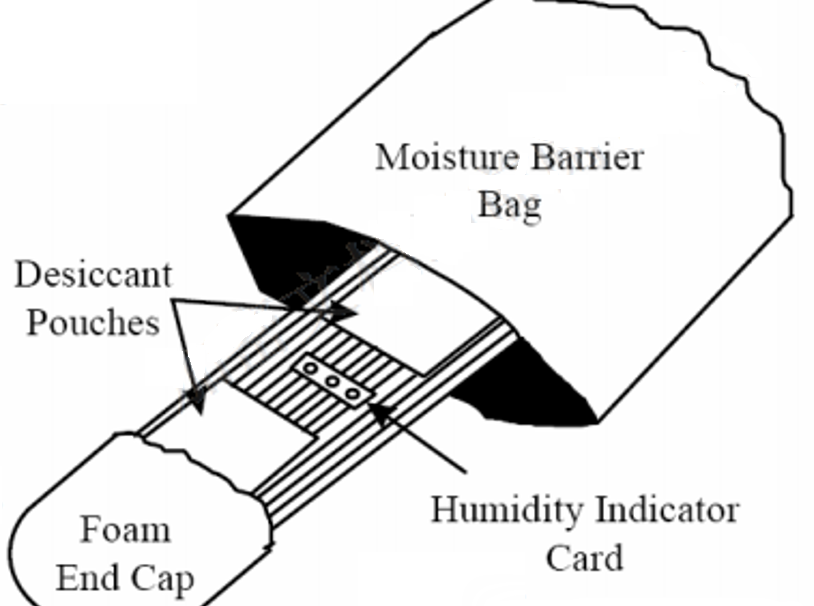
When receiving MSD materials, the material warehouse should check the integrity of the bag (MBB), including the presence of holes, chisel holes, tears, pinholes, and any other openings that would expose the interior.
If any are found, refer to the status displayed on the Temperature and Humidity Indicator Card (HIC) to decide whether to provide feedback. Record the date of sealing as the start of shelf life.
| MSL Level | Baking Required | Moisture Barrier Bag | Desiccant | MSL Label | Caution Label |
| 1 | Optional | Optional | Optional | Optional | Not required at 220°C Required at 235°C |
| 2 | Optional | Required | Required | Required | Required |
| 2a-5a | Required | Required | Required | Required | Required |
| 6 | Optional | Optional | Optional | Required | Required |

Storage of MSDs
Storage of MSD devices is subject to one of the following conditions:
- Stored in MBB vacuum-sealed bags with desiccant.
- Stored in a desiccator.
MSD device storage temperature and humidity:
- Workshop temperature 23℃±5℃, humidity 40%-75%RH;
- Warehouse temperature 23℃±5℃, humidity 30%-70%RH.
Note:
- MSD devices are taken only in quantities needed for production at a time.
- Take them as soon as they are used, and then quickly seal the moisture-proof bag or place them in a dry box.
- Remaining MSD devices within 8 hours must be vacuum sealed or placed in a dry box with the HIC and desiccant. If exposure exceeds shelf life, they must be dried.
- Label pallets or bags for storage records and tracking management.
- Confirm the dryness of MSD devices before use and dry them accordingly if necessary.
- Wear anti-static devices and gloves when picking up and placing MSD devices.
Baking Requirements
Depending on the exposure, MSD components need varying degrees of baking and disposal when they are unpacked:
MSD Post-Exposure Recovery Rules
| Condition | MSL Levels | Recovery Method | Critical Parameters |
| Non-humidity exposure (≤30min at ≤30°C/60% RH) | All Levels | Store in dry cabinet (≤5% RH) or reseal with original desiccant | Desiccant reusable if exposed ≤30min |
| Exposure ≤12H | 2, 3, 4 | Re-drying holding time = 5× exposure time | Dry cabinet: ≤10% RH Desiccant bag: New desiccant |
| Exposure ≤Floor Life | 2, 2a, 3 | Store in ≤10% RH dry cabinet | Exposure clock pauses (Time reset after storage) |
| Exposure ≤8H | 5, 5a | Re-drying holding time = 10× exposure time | Dry cabinet: ≤5% RH Post-drying: Reset exposure clock |
| Baking requirement | All Levels | Follow original bag caution label | Default: 125°C/24h (per J-STD-033 §7.2) |
- MSD rework is recommended to use local heating, device surface temperature control within 200 ℃.
- If the device temperature exceeds 200 ℃, and more than the specified Floor Life, rework before the need to bake the PCBA.
Soldering Failure Analysis of Moisture Sensitive Devices
Failure due to moisture sensitivity mainly occurs during the reflow soldering process. This is because the temperature of the device is almost equal to the soldering temperature. As a result, moisture expands dramatically, which can lead to delamination of the device, thinning of the leads or even fracture.
Try to check these reasons when problems occur:
- Moisture can seep into the chip surface along the pin-to-plastic interface due to the plastic material’s poor adherence to the metal pins.
- Since plastic is not a thick substance, moisture from the plastic seeps directly into the chip surface over time.
- The material used to package chips is too thin and insufficient, and moisture is easily absorbed.
- Before the gadget is placed into the sealed package, it may be baked for too long or at a temperature that is too low.
- Moisture infiltration occurs when the bag’s closure is inadequate or broken.
- For a variety of reasons, the device is not used up after being unpacked, is not promptly sealed into the dry package, and is reassembled without being dried.
- The humidity in the warehouse or production workshop exceeds the standard, or the device is exposed to the air for longer than the environmental storage time specified in the MSL level table after the bag is unpacked.
- There is insufficient preheating time or the reflow temperature is too high before reflow soldering.
Conclusion
Moisture-sensitive devices are silent assassins in PCB assembly – invisible until reflow cracks reveal their damage. Partnering with a reliable manufacturer can reduce the risk of rework and get high-quality PCBA products. Choose ELE PCB and you will:
- ✔️ You reduce rework costs by up to 37%
- ✔️ Extend component shelf life through J-STD-033-compliant storage
- ✔️ Eliminate latent field failures in automotive/medical PCBA
Contact us for expert support!


CONTACT US





 English
  Italian
  Hungarian