

Table of Contents
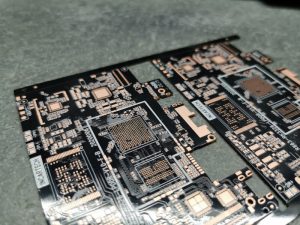
What is Purple PCB?
- Solder masks prevent oxidation and mitigate short circuits.
- Solder masks serve as insulators between components that have closed traces.
- Solder masks bind with the substrate and give mechanical strength.
- Solder masks only allow solder paste to get into the right areas.
What are the Specification Ranges of the Solder Mask Layer of Purple PCBs?
Table 1 Details of Solder Mask Specifications
| Solder Mask Specifications | Details |
| Factors Controlling Dynamic Resolution Range | Components, Traces, Thickness and Material of Involved Layers |
| Thickness of Mask Layer | 0.2mil – 1.6mil |
| Solder Barrier for Green Mask | 4mil |
| Recommended Solder Dam for Other Colors | 5mil |
- The wet film thickness for this material before curing shall be 20–30 mm, with a dry film thickness after curing of 9–11 mm.
- Talking about color consistency, since this color is not that common, it can be difficult to produce PCBs that have the same color across batches. It all depends on the curing process and manufacturing steps.
- Talking about adhesion, the mask should be able to withstand pressure during the manufacturing process by strongly adhering to the copper face. Adhesion strength should lie between 2B to 3B on the D3359 test.
- For purple PCB, it is important that the tolerance for pads and traces is optimum. To effectively get the right Purple PCB, the tolerance for registration should be around 50 mm.
- In order to effectively qualify for purple PCB, it should be able to withstand scratches and wear-tear. The hardness of purple PCB should be greater than 6H on the scale of the D3363 test.
- Purple solder masks should be able to handle extreme soldering temperatures of up to 290 degrees for more than 20 seconds.
- To prevent short circuits, the Di-electric strength of purple PCB should be 600-1000V/mil.
Additional Parts of Purple PCB Compared to Other PCB Color Types


- The first part of purple PCBs is that these PCBs are created using specific color agents to keep the same color consistency. Moreover, additional layers of UV protection are also used because purple is more sensitive than other colors such as green or red.
- To improve the color enhancements, purple PCBs are equipped with premium silk screen colors such as silver or golden so that assemblers can easily read the PCB. Moreover, purple PCBs are used for limited-edition projects that contain additional artwork, logos, and custom designs.
- Purple PCBs contain high-end materials such as substrates with high tg, ENIG gold-pated pads, and MCPCBs for improved results.
- Lastly, to ensure that purple PCB meets the required functionality and aesthetic appeal, additional QA tests such as color uniformity tests and improved registration process.
Factors that Make Purple PCB
a Perfect Choice in PCB Manufacturing
1.Aesthetics and Brand
2. Optimization of EMI/EMC Shielding
3. Improved Thermal Performance
4. Follow Environmental Restrictions
Major Differences Between Purple PCB and Green PCB
| Purple PCB | Green PCB | |
| Layout |
Purple PCBs are chosen for aesthetics and unique appeal. The contrast of purple PCB is lower and this makes it difficult for troubleshooting. Are used in electronics that are premium. |
Green PCBs are used for bulk production. Green PCBs are common in the industry and have the capability of offering contrast for debugging and component placement. Green color provides a clear view of solder joints, assisting in system design. |
| Assembly |
Purple PCBs require manual processing due to lower visibility. Can lead to higher costs because assemblers have to do additional settings. Are not easily available, leading to delays in projects. |
Green PCB are used in automating manufacturing processes. Perfect for the soldering type that includes reflow and wave. Green PCB faults are easily traceable in the assembly line because the equipment is calibrated for green masks. |
| Recycling |
Purple PCBs are difficult to recycle because of additional dyes and colors. These PCBs have additional layers, which makes it difficult to recover materials like metal and gold. |
Green PCBs are more common, hence their materials are designed to be more environmentally friendly. These materials can reduce the cost of recycling and provide easy ways. |
Purple Electronics
-The Electronic Component Side of Purple PCB vs Others


Branding Components
- With other colors, standard industry-common components are used without worrying about the color. The housings and LEDs are also of standard color, such as green, white, and red.
- Purple PCBs are used in areas where it is important to show that the product is distinct and custom-made. So, to match the color of the PCB, components like connectors, terminals, and headers are sourced in purple color. Moreover, purple color LEDs are used to further enhance the appearance.
Optical and Thermal Components
- The color is not related, but PCB colors like black have the capability of causing more heat retention than purple PCBs. This can affect heat-sensitive components.
- Moreover, if there are optical components, purple can help in offering more distinctive as they reflect and have the capability of less light absorption.
Components that are Brand-orientated
- Like in the branding section, ICs and controllers can be purple color and can contain custom-made housings to improve the look of the board.
- Moreover, Purple PCBs are paired with silver and gold layers, compared to green PCBs that have black or blue components.
Cost and Availability of Such Components
- Components that are compatible with standard colors are easily sourceable and have lower costs.
- Sourcing components for Purple PCBs can become expensive due to lower demand and are not easily available.
Conclusion
FAQs
- Using purple pigments and adding them to liquid solder mask material
- Using base color (e.g. white) and then using the printer and purple legend ink to print on the base mask.
- Medical industries
- Consumer electronics
- Automobile electronics
- Defense and aerospace industry


CONTACT US





 English
  Italian
  Hungarian